Visar inlägg med etikett Elephant Voices. Visa alla inlägg

torsdag 9 februari 2017

The possible end of trade with so called antique ivory

Elephants are heading towards extinction. Between 1930 and 1940, according to the world Wildlife Fund for Nature (WWF), there were between 3 and 5 million African elephants alive in the wild. Today, because of an explosion in illegal poaching, the number has declined to just 400,000. An elephant is poached every fifteen minutes, all year round. Unless we, the human race, put a stop to this, the largest mammal on earth will be gone in a couple of generations.

The Mabenzi Family, Gorongosa National Park. Photo: ElephantVoices
Most people active in the antiques trade knows exactly why this is happening. The illegal trade in elephant ivory is flourishing today. According to international rules, ivory objects made after 1947 are illegal to trade with. But these rules are being routinely flouted by dealers and auction houses around the world.

CITES was drafted as a result of a resolution adopted in 1963 at a meeting of members of IUCN (The World Conservation Union). On 1 July 1975 CITES entered in force. For many years CITES has been among the conservation agreements with the largest membership, with now 183 parties. Only "worked" ivory specimens acquired before 3 March 1947 can be considered antiques and therefore legally be traded.

Guanyin ivory figurine on the Danish Auction Market in 2013, with a -according to Antikmonologen- bogus provenance. Withdrawn straight away, after Antikmonologen published, discussed and dismissed the provenance. It was re-entered on the market in January 2014 and then sold for 30.000 DKr, circa £ 2.700. The provenance had by then been conveniently altered.

As an antique dealer with a great interest in Oriental works of art, I have taken special interest in ivory that has been bought and sold in Sweden as well as internationally. What has struck me over and over again is how auction houses seemingly arbitrarily date objects made of elephant ivory as "late 19th Century" or "early 20th Century" even though they could very well have been made during the latter part of the 20th Century. It has become an "Auction House Standard", probably to avoid the eyes of the authorities and others that might question a catalogue entry.


I have been able to prove large anomalies over and over again with catalogued ivory objects in Sweden, Denmark, Germany, England and Asia during five years of writing the blog-post Antikmonologen. The sales of ivory has drastically dropped in Sweden since Antikmonologen started to penetrate the subject, in 2013. I act as a consultant to many Swedish auction houses -that want to do right- and frequently receive questions regarding ivory items; both from the trade and from the public.

Over the past few years I assisted the WWF of Sweden in addressing the ivory crisis, and in 2016, I was asked by the researchers for the BBC series Saving Africa´s Elephants; Hugh and the Ivory War, to point out suspicious ivory items that were for sale on the open market in England. In doing so, the BBC were able to show that seven out of ten ivory objects that they bought were made after 1947, i. e. illegal to sell.


In October 2016 I visited the largest Antiques Fair in Europe, Mercanteinfiera, with over 1,000 exhibitors, in Parma, Italy. The problems with numerous modern objects made from elephant ivory were in abundance. It was absolutely devastating to see how easily accessible all the ivory was, and to what extent. Smaller objects such as snuff bottles and netsukes were sold by hundreds of dealers. Several dealers sold very large and/or expensive items marketed for tens of thousands of Euros each. All items that I asked about were labelled as either "antique", "19th century" or "early 20th century" ivory, in stark contrast to my opinion. Most of the expensive items were sold with more or less home-made-looking certificates. Certificates are much easier to fake than the actual object. The Mercanteinfiera Fair takes place two times per year.


Unfortunately, according to the way the rules and regulations are set up, it is far too easy to claim the so called Antique exception and sell virtually any object made of ivory, claiming that it is from before 1947. It has become common practice for auction houses, when questioned whether or not an ivory object is old enough to be sold, to claim the Antique exception. In other words, auction houses are acting as both judge and salesman. They have a vested interest in judging ivory objects to be old enough, otherwise they are not able to sell them.
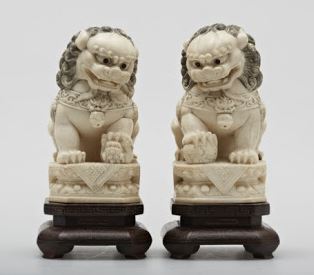
A pair of ivory Fo-dogs catalogued by one of the biggest Swedish Auction houses in August 2013 as: "Guardian lions, possibly China, 19th-20th Century, ivory. Virtually no wear. Condition over all probably good". At this particular instance, the police charged in to the actual physical hammer auction and confiscated a large number ov ivory items. The Auction house were then charged twice, in the Swedish judiciary system and freed both times. The so called Antique exception saved them. Their own expert, married to the owner of the Auction house in question, promised two courts that all ivory included in the auction pre-dated 1947.

More or less local solutions for ivory sales are applied, with the US as the market with the strictest rules and the Chinese recently having said that they will prohibit ivory trade alltogether by the end of 2017. How and to which effect remains to be seen.

Atomic blast. Photo: Cryhavok.org

Is there a solution to the ivory dating problem? The simple answer is yes, without any form of doubt. There are around 125 laboratories around the world that perform AMS (Accelerator Mass Spectometry) radio carbon dating. And since the crucial year is 1947, it is very easy for any of those laboratories to determine the age of the object in question. The reason for this is that the first ever nuclear detonation took place in New Mexico, US, on the 16th of July 1945. There were 2053 nuclear explosions between 1945 and 1998. As explained to me by Professor Göran Possnert at the Tandem Laboratory in Uppsala, Sweden, this makes it relatively simple to date organic material from 1945 onwards with great precision.

Fancy ivory/silver lidded cup for sale at the Mercanteinfiera Antiques Fair in Parma, October 2016. The salesman said it was made during the early part of the 18th Century. The laminated certificate said "Fin de XIXeme Siecle (end of 19th C)" (the vendors were French). When I questioned the 18th Century dating, the salesman changed his opinion to what the certificate said. Antikmonologen dates the entire object to around the year 2010. The asking price was 15.000 Euros.
So, is this very simple way of determining the age of ivory objects being used to any extent by the Auction houses (who totally dominate the high end market of the ivory business)? Alas, the answer is "No". The rather spurious pretexts from auctioneers has been that collectors do not want drill holes in the objects they might purchase or that the AMS tests are too expensive to perform. Or that it would not be a viable alternative to date all ivory objects and that the experts in the trade can date the objects themselves, from appearance only.

Too big.
The drill hole argument is not good enough, since the sample needed is minute according to Professor Possnert. -It is very easily disguised. The argument that the experts can date the objects themselves is correct to a certain extent, but it should be noted that ivory is an organic material that is very easily patinated and the Chinese are sublime patinators (it goes without saying that objects are carved in antique styles). Also, the risk of a cataloguer dating an object as from before 1947, just to be able to sell it, is as earlier pointed out, obvious.

It all boils down to the actual cost of an AMS test. In Sweden it would be around 3000 Swedish kronor plus VAT. The cost in England would be around £500 plus VAT. However, according to Professor Possnert in the AMS laboratory in Uppsala, the testing for age of ivory objects is virtually never asked for, neither by private persons nor by organizations.

Does the above mentioned imply that all ivory items suspected of being post 1947 should be destroyed? Of course not. But my suggestion is that all items consisting of, let us say, more than 20% ivory should be tested, when they come up for sale. Always, with no exception. This ought to put a stop to most of the selling of elephant ivory. As soon as you make exceptions to that rule, the need for some type of jury comes up and that would complicate matters unnecessarily. How very obvious pieces are to be dealt with, for instance objects with known, specific provenances, is for the international community, EU/CITES to decide. Should they be excluded from the "absolute" demand for AMS-test? I personally think so, but the survival of elephants is at risk, so maybe no exceptions to the AMS-demand should be accepted. It certainly is complicated, but needs to be addressed. Now!

Potential buyers at the Mercanteinfiera Antiques Fair in Parma, October 2016, admiring one -of a pair- of Ivory vases. They were dated as "late 19th Century". Antikmonologen begs to differ and consider them to be from circa 2010. Asking price 20.000 Euros.

The obvious solution to the ivory crisis is to implement an obligatory AMS test for all ivory items that comes up for sale. Strong forces are at hand, and they bring modern, antique-patinated ivory carved in an antique manner on to the Antiques market. Once an ivory object is sold as "antique" or labelled as pre- 1947, it is generally accepted as "kosher" or okey for all times, by the trade. A form of laundering.

We have come so far that £300-500 should not be allowed as the cause of obliterating the elephants as a species, the largest mammal still walking on earth. Nota bene; still.


Hugh Fearnley-Whittingstall in front of piled up ivory tusks, working with the BBC1 series Saving Africa´s Elephants. Photo:BBC

----------------------------------------------------------------------------------------------

Background on the author of this article, Nicklas Cederqvist:
Art Historian, Antiques and Art dealer, Writer of the biggest blog post in Sweden on the Antiques trade; Antikmonologen.blogpost.se. Educated at the University of Stockholm and Sotheby´s Institute, London.

Links:
http://antikmonologen.blogspot.se/2013/08/uppsala-onlinekvalitetsauktion-avsager.html
http://antikmonologen.blogspot.se/2013/09/elefantdod-inte-elefantol-och-skandaler.html
http://antikmonologen.blogspot.se/2016/10/europas-storsta-antikmassa.html
https://bruun-rasmussen.dk/m/lots/DAF6CE16B4E9?src=http%3A%2F%2Fwww.bruun-rasmussen.dk%2Fsearch.do%3Fpg%3D1%26q%3Delfenben%26iid%3D300592136%26mode%3Ddetail


onsdag 28 maj 2014

Crying Buddha sold at Woolley & Wallis in Salisbury

Every 15 minutes an elephant is poached, 365 days per year. If this is allowed to continue, the greatest landliving mammal on mother earth will be extinct within a generation or two.
Illegally poached elephant. Photo: Baraza.wildlifedirect.org
For the past 28 months I have been writing blog posts (in Swedish) on subjects that are related to the Antiques and Arts trade. Frequently I discuss subjects that other sources for some reason or another ignore. One subject that lies close to my heart is elephant ivory. I have proven that several auction houses have been trying to sell ivory that has been worked on long after 1947, -the critical year in regards to the CITES Convention (the Convention on International Trade in Endangered Species of Wild Fauna and Flora). Ivory objects that are proven to stem from before 1947 are legal to buy or sell, and illegal if they are from after 1947. Proper paperwork is necessary to prove a correct provenance.

As an antique dealer specializing in Oriental Antiques, I frequently browse the internet and the other day I took interest in a Woolley & Wallis (W&W) Auction Catalogue in Salisbury, England. More specifically their latest Oriental sale, that took place on the 21-22 of May, 2014.

The number of items made of or including ivory amounted to 77, a staggering number considering that auction houses ought to be quite restrictive in admitting pieces made from elephant ivory. Be that as it may. That is a difficult discussion to pursue.

Since I first discussed the problem of auction houses trying to sell (potentially) new ivory, the attempts to sell ivory have dropped drastically in Sweden (see the blog post Six-finger-Jane-returns; Now even older and WITH a provenance! (please use the google translate-button for translation).

Ms and Mr "Six-finger-Jane", circa 15,5 cm.

Detail: Happy -modern-facial features...
"Jane´s" six fingers clasping the ewer of brew.
I nick-named an ivory figure "Six-finger-Jane" that was first(?) put up for sale in the autumn of 2013 in south Sweden (Helsingborgs Auktionsverk (HAV)) and did not meet its reserve. Before the sale, I pointed out that the pair of figurines were of exceedingly banal quality and produced in a way that implied a very late date. HAV offered it for sale in 2013 and had no (printed) provenance to offer and dated the two figurines as "early 20th Century" at 8000 SKr, roughly £719. As earlier stated and to no-one´s surprise they failed to sell. Atypical smiling faces, a general stiffness to the carving and an extra finger to the left hand of the woman were facts among others that drew me to the conclusion that these figurines were of a later year than 1947. Also, a curiously gigantic ring finger was noted. This pair of figurines is now offered by another Swedish auctionhouse, Skånes Auktionsverk. This time with a rather specific provenance and dated slightly earlier and with a slightly higher suggested price span.

Now, look at lot number 478, in Woolley & Wallis Asian Art II- 22 May 2014:
Lot nr 478, "A large Chinese ivory carving of Budai He Shang c.1900", 23,2 cm.
This smiling, semi-clad, rather chubby chap, so called Budai He Shang by W&W´s experts, (often also referred to as a laughing Buddha/Budai) is rather interesting. The estimate was £300-500 (3340-5568 SKr) but it sold for quite a bit more, namely £2.500 (27.843 SKr). Please compare Ms Six-finger with our laughing friend. I need not delve very deep into the general stiffness of all three of these figurines. They are all so poorly executed, that it is appalingly obvious that they could not possibly have been made in around the year 1900. Oh, maybe one more thing. While you are at it, throw a glance at Mr Happy Buddha´s right foot, please:
Detail of lot nr 478, at Woolley & Wallis.
Here we have an item that has been catalogued by professional auctionhouse employees as circa 114 years old. An item that was carved from purportedly -at least- a 114 year old elephant´s tusk. The Chinese artisan who carved this tusk ought to have been a master with the carving tools, regarding how highly ivory was esteemed at the time.

I can hear the boss of the Ivory carving workshop shout: WHERE did you place the toe nails, you moron?! And on another day maybe the same boss was heard shouting to the very same employee: HOW many fingers did you do on that hand, you IDIOT!? I hereby suggest that these figurines were both made by the same copyist carver, please note the choice of wording, I did not write artist carver.

You may still think that it must be the real and genuine deal, since it "sold for so much money". Here´s the irony of it all; I am guessing that the buyers of pieces like this are men with very thick wallets, but possibly not so thick on the knowledge side of it all.

The Buddha-with-the-crazy-foot is probably bound for mainland China. The subject of Chinese buyers of Chinese fake items has been extensively discussed by Antikmonologen.
The Guardian, the 22nd of May, 2014.
All the above might sound funny at first glance, but I assure you I am not laughing. There is so much money in ivory that many strong forces keeps the illegal trade going. Organizations such as Elephant Voices and World Wildlife Foundation (WWF) keep highlighting the precarious situation of the elephants. WWF have pointed out that there are links between organized crime and the ivory trade. The Swedish branch of WWF ran a campaign in 2013 and petitioned for the Swedish auction houses to bring a complete halt to the trade in ivory(-related artefacts). I am pretty certain that the auction houses of the world would protest strongly against that. Ivory was included in a plethora of items up until the plastic era, so it certainly might be difficult to implement.

On the other hand, if auction houses and front-line experts keep admitting and selling obviously modern ivory artefacts, our children will be without the majestic creatures that I so much love. One auction house in Sweden, Uppsala Auktionskammare, will be brought to court for violating the CITES Convention (Uppsala Auctions -PROBABLY- gives up responsability for Asian Antiques). How is it possible for a big auction house to sell pieces like the ones discussed in this blog, that could be spotted by anyone mildly talented and interested in works of art, as banal, recent work? Finding six fingers on one hand or toe nails on the underside of a foot from the late Qing period is like spotting a Volkswagen Beetle in a Rubens oil painting.

The marketplace Ebay announced in 2008 that ivory sales were banned with them. That is not at all the case. Click away for a minute or two on the web. Yet another sad story.
"2 19th Century faux ivory, gentlemans cloth brushes.armorial, monogrammed"(sic.) For sale at Ebay on the 28th of May. Nothing faux about that.
The fact that Chinese ceramics are extensively faked and offered all over the world as old, is a very sad story indeed. The problem is hardly new and we see auction houses, dealers and Fair traders who more or less knowingly keep up the work of selling hoax objects to the market. A market that on the whole is unaware of what is going on. But, the experts must know. And do they mention or question that? If you ask me, the answer is very often NO. As John Cleese put it in the comedy Fawlty Towers; Do NOT mention the war. I believe the market is rather cynical; Oh, some rich person from China just bought a pottery bowl for lots of money. Was it new, catalogued as old? -Heck Yeah! But he can probably afford that "loss" or negative investment.

A small auction room called Kolonn in Stockholm, Sweden, tried to sell the following vase today (28th of May):
Lot 154906, "Vase, porcelain, China, probably 19th Century, estimate £135".
Detail of the above
Anyone with a rudimentary interest in Chinese blue and white porcelain, knows that a vase like the one illustrated did not exist during the 19th Century. It is a very poorly executed fake, some might call it copy, of a Yuan (1279-1368) vase. It is catalogued by supposedly professional people, in a professional environment that purports to take full responsibility for correct catalogue entries. I call it Antique-phishing. I see hundreds of examples of totally mis-catalogued mainly Chinese ceramics, every day, 52 weeks per year. Does anyone "important" speak up or protest? Not as far as I know. Do not mention the war. Mind your OWN business. The vase failed to sell.

There is one fundamental difference between all the Chinese fake ceramics and the overwhelmingly questionable Woolley & Wallis laughing Buddha (I prefer to refer to him as a crying Buddha). The difference being that for every elephant ivory piece that is sold, there will be another client looking for new items. Be that antique or new. In other words, the elephants will keep on being slaughtered for their tusks.

How often is an elephant poached?
What it always comes down to
Is it worth it, John Axford, Deputy Chairman of Woolley & Wallis, one of the familiar faces of the British Antiques Road Show and other auctioneers of the world? How big would the "loss" in income be for the auction houses of the world in total, if you started to really impose the rules of CITES?
In it for the money? (John Axford, photo: Woolley & Wallis)
...Grab that cash with both hands and make a stash
New car, caviar, four star daydream,
Think I'll buy me a football team
Money get back
I'm all right Jack keep your hands off my stack.
Money it's a hit
Don't give me that do goody good bullshit...
Pink Floyd, -parts of lyrics to the song titled "Money"


Footnotes:
I dedicate these lines to the fantastic person and great expert Gordon Lang, whom is no longer with us. Rest in peace Gordon, may you be surrounded by great pots, wherever you are.

The Qing period lasted between 1644-1912, the first Volkswagen Beetle was produced in 1938 and
the magnificent artist Peter Paul Rubens lived between 1577-1640.


Sources:
http://www.woolleyandwallis.co.uk/Search?q=ivory

http://www.woolleyandwallis.co.uk/Lot/?sale=AA210514-2&lot=478&id=269465

http://www.cites.org/eng/disc/what.php

http://www.theguardian.com/world/2014/may/22/chinese-museum-closed-down-fake-exhibits-lucheng

http://en.wikipedia.org/wiki/Volkswagen_Beetle

https://auctionet.com/sv/154906-vas-porslin-kina-trol-1800-tal

http://www.azlyrics.com/lyrics/pinkfloyd/money.html

https://www.youtube.com/watch?v=ZwU8QeW4ofU

http://www.standard.co.uk/news/uk/ebay-traders-are-flouting-ban-on-ivory-by-calling-it-faux-9119071.html